- News
- Sport
- Politics
- Sci/Tech
- Showbiz
- Health
- Business
- Art
- Fashion
- Education
- Weather
- Automotive
- Aviation
- Religious
- Crime
1 image
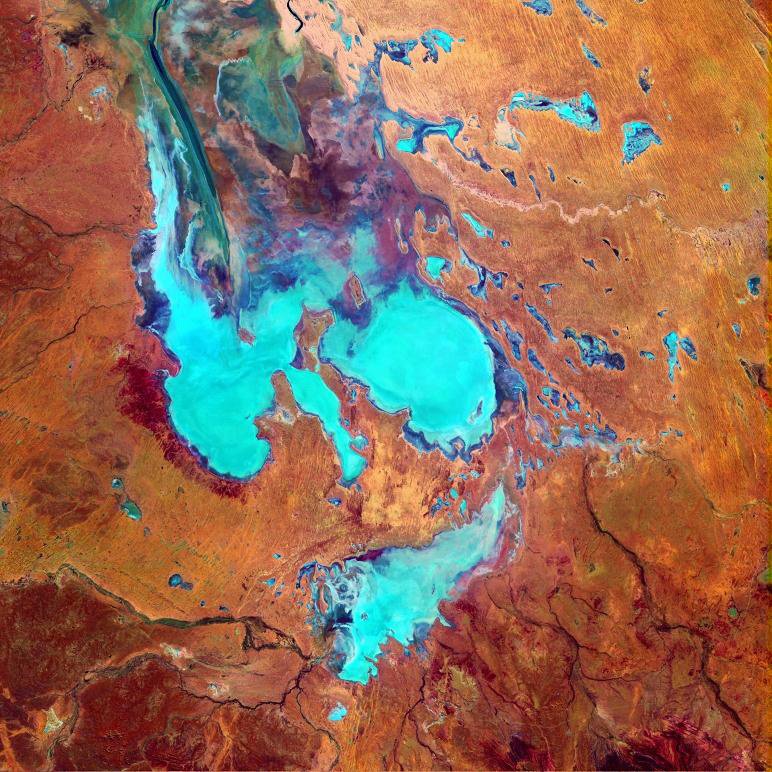
Kati Thanda???Lake Eyre
Lake Eyre, officially known as Kati Thanda???Lake Eyre, is an endorheic lake in the east-central part of the Far North region of South Australia, some 700??km (435??mi) north of Adelaide. It is the largest ephemeral endorheic lake on the Australian continent, covering over 9,000??km2 (3,500??sq??mi). The shallow lake is the depocentre of the vast endorheic Lake Eyre basin, and contains the lowest natural point in Australia, at approximately 15??m (49??ft) below sea level. The lake is most often empty, filling mostly when flooding occurs upstream in Channel Country, but almost always partially. On the rare occasions that it fills completely, it is the largest lake in Australia, covering an area of up to 9,500??km2 (3,668??sq??mi). When the lake is full, it has the same salinity as seawater, but becomes hypersaline as the lake dries up and the water evaporates. To the north of the lake is the Simpson Desert.
e: 72080187869707451
Strings (5)
-
str_k__gdb_alternateName
str.gdb:alternateNameKati Thanda|Lake Eyre -
str_k__gdb_geoNamesId
str.gdb:geoNamesId2071734 -
str_k__gdb_image
str.gdb:imagehttps://upload.wikimedia.org/wikipedia/commons/c/c6/NEO_lake_eyre_big.jpg -
str_k__gdb_openStreetMapRelationId
str.gdb:openStreetMapRelationId253952 -
str_k__rdfs_comment
str.rdfs:commentLake Eyre, officially known as Kati Thanda???Lake Eyre, is an endorheic lake in the east-central part of the Far North region of South Australia, some 700??km (435??mi) north of Adelaide. It is the largest ephemeral endorheic lake on the Australian continent, covering over 9,000??km2 (3,500??sq??mi). The shallow lake is the depocentre of the vast endorheic Lake Eyre basin, and contains the lowest natural point in Australia, at approximately 15??m (49??ft) below sea level. The lake is most often empty, filling mostly when flooding occurs upstream in Channel Country, but almost always partially. On the rare occasions that it fills completely, it is the largest lake in Australia, covering an area of up to 9,500??km2 (3,668??sq??mi). When the lake is full, it has the same salinity as seawater, but becomes hypersaline as the lake dries up and the water evaporates. To the north of the lake is the Simpson Desert.